Imagine you are reading a long email. It goes on and on. You lose interest. You stop reading. This happens because the writer did not keep it short. In the digital world, time is money. People want information fast. That is why choosing the right synonyms for brief can completely change how people react to your words.
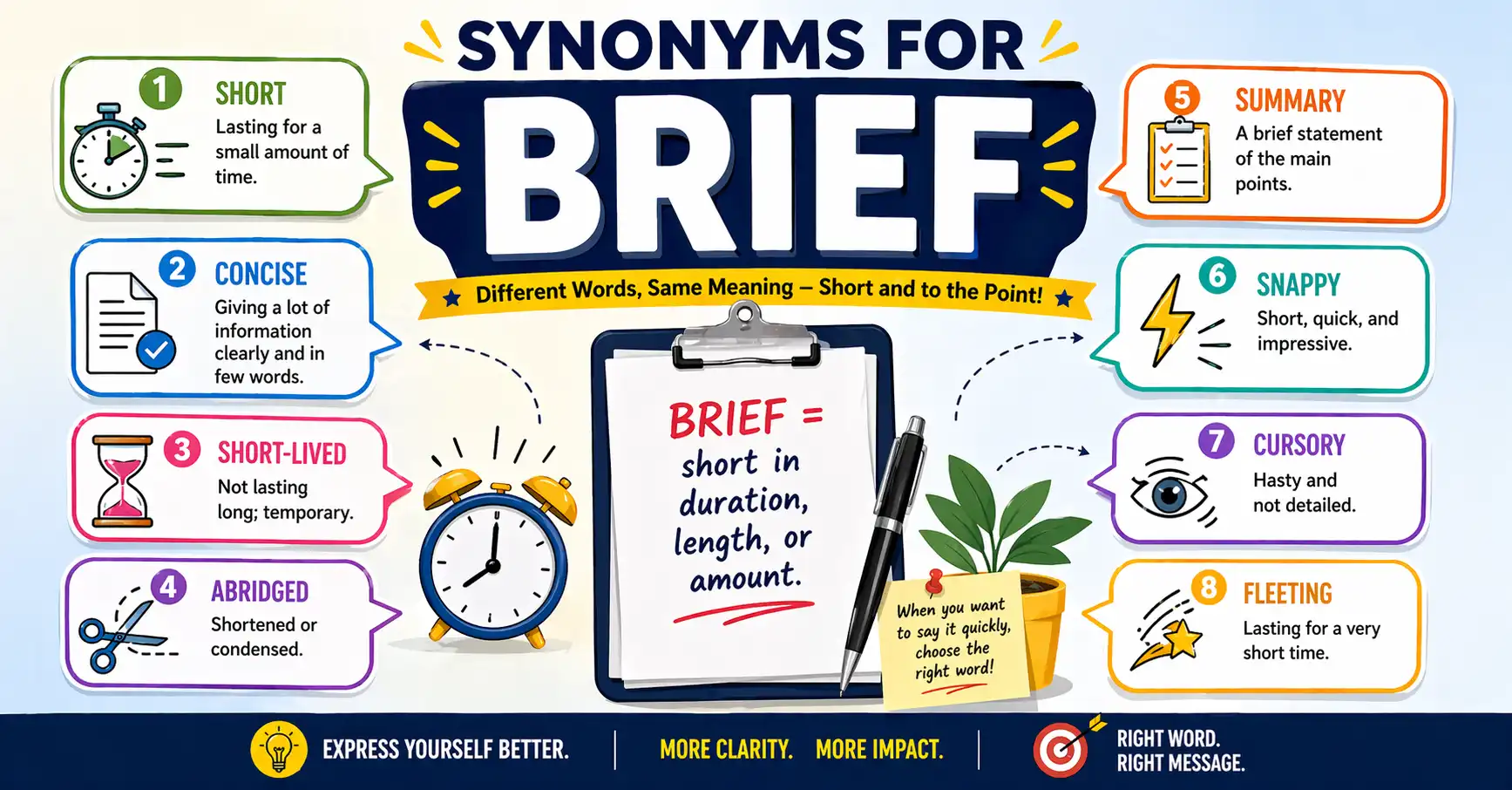
But what does brief actually mean? In simple terms, brief means short. It means using only a few words. It means not taking up too much time.
Learning synonyms for brief is a superpower. If you are a student, it helps you write better essays. If you are a blogger or content writer, it keeps your readers glued to the page. For daily English users, it makes your emails sharp and professional. Let’s explore these excellent word choices to upgrade your vocabulary today.
1. Short
Meaning: Something that does not take a long time or have much length.
Examples:
- The teacher gave a short speech before the exam.
- I took a short walk in the park this morning.
2. Concise
Meaning: Giving a lot of information clearly and in very few words.
Examples:
- Your summary of the book needs to be concise.
- She wrote a concise note to explain the plan.
3. Crisp
Meaning: Sharp, clear, and pleasingly short.
Examples:
- The marketing team loves crisp sentences in ads.
- His reply was crisp and to the point.
4. Curt
Meaning: So short that it seems a bit rude or blunt.
Examples:
- The busy clerk gave me a curt answer.
- She sent a curt text message to say no.
5. Blunt
Meaning: Direct and brief without trying to be polite.
Examples:
- To be blunt, we are running out of money.
- His feedback on my drawing was honest and blunt.
6. Abrupt
Meaning: Sudden and short in a way that surprises people.
Examples:
- The music came to an abrupt stop.
- The meeting ended in an abrupt manner.
7. Terse
Meaning: Using very few words, often showing that you are annoyed.
Examples:
- He left a terse note on the kitchen counter.
- Her email response was polite but terse.
8. Compact
Meaning: Closely packed together or neatly packed into a small space.
Examples:
- The author wrote a compact guide for travelers.
- This laptop has a compact design for easy carrying.
9. Pithy
Meaning: Short but full of heavy meaning or clever force.
Examples:
- The speaker shared a pithy saying about success.
- I love reading pithy quotes on social media.
10. Succinct
Meaning: Expressed clearly in a small number of words.
Examples:
- Please keep your answers succinct during the interview.
- The news anchor gave a succinct update on the storm.
11. Epigrammatic
Meaning: Short, clever, and funny like a good poem or joke.
Examples:
- Oscar Wilde is famous for his epigrammatic style.
- The comedian made an epigrammatic comment about life.
12. Aphoristic
Meaning: Short and containing a wise truth about life.
Examples:
- My grandfather always speaks in an aphoristic way.
- The book is full of aphoristic wisdom for teens.
13. Summary
Meaning: Done quickly and covering only the main points.
Examples:
- The manager gave a summary report of the sales.
- We need a summary judgment on this case.
14. Rapid
Meaning: Happening very fast or taking a very short time.
Examples:
- The city saw a rapid growth in new businesses.
- He made a rapid recovery from his cold.
15. Fleeting
Meaning: Passing by very quickly and lasting for just a moment.
Examples:
- I caught a fleeting glimpse of the deer in the woods.
- Joy can sometimes feel like a fleeting emotion.
16. Quick
Meaning: Done or happening in a small amount of time.
Examples:
- Let’s have a quick chat before you leave.
- She took a quick look at the clock on the wall.
17. Swift
Meaning: Moving or happening with great speed.
Examples:
- The river has a swift current after the rain.
- Thank you for your swift reply to my question.
18. Fast
Meaning: Taking a short time to move or do something.
Examples:
- This is a fast way to solve the math problem.
- We made a fast trip to the grocery store.
19. Snappy
Meaning: Quick, lively, and instantly engaging.
Examples:
- Write a snappy title for your new blog post.
- The song has a snappy beat that makes you dance.
20. Sententious
Meaning: Short and trying to sound very wise or moral.
Examples:
- The old man gave a sententious speech to the kids.
- I dislike sermons that are too sententious.
21. Summary-like
Meaning: Resembling a short overview rather than a full story.
Examples:
- Her diary entries are very summary-like.
- The video gave a summary-like view of history.
22. Miniature
Meaning: Very small or a tiny version of something larger.
Examples:
- He builds miniature houses out of wood.
- We had a miniature celebration at the office.
23. Pocket-sized
Meaning: Small enough to fit in a pocket or easy to carry.
Examples:
- I bought a pocket-sized dictionary for school.
- This pocket-sized tool has ten different uses.
24. Little
Meaning: Small in size, amount, or time length.
Examples:
- We have a little time left before the train comes.
- She told a little story to make us laugh.
25. Minute
Meaning: Extremely small or lasting a very short time.
Examples:
- The dust particles are minute and hard to see.
- He paid attention to every minute detail.
26. Petite
Meaning: Small, thin, and delicate in size.
Examples:
- The shop sells clothes for petite women.
- She lives in a petite cottage by the sea.
27. Slight
Meaning: Small in amount or degree, or not lasting long.
Examples:
- There is a slight chance of rain today.
- I felt a slight pain in my foot while running.
28. Tiny
Meaning: Very small in size or amount.
Examples:
- The baby has tiny fingers and toes.
- Just add a tiny pinch of salt to the soup.
29. Instantaneous
Meaning: Happening immediately or in a split second.
Examples:
- The internet gave us instantaneous access to data.
- Her reaction to the funny joke was instantaneous.
30. Momentary
Meaning: Lasting for only a single moment.
Examples:
- There was a momentary pause in the conversation.
- He experienced a momentary lapse in memory.
31. Passing
Meaning: Lasting only for a short period as it moves by.
Examples:
- It was just a passing thought, nothing serious.
- She noticed a passing car outside her window.
32. Transient
Meaning: Lasting for only a short time before disappearing.
Examples:
- The warm weather in winter was transient.
- Heavy rain caused a transient flood on the street.
33. Ephemeral
Meaning: Lasting for a very short time like a single day.
Examples:
- Fame can be ephemeral in the world of internet trends.
- The beauty of spring flowers is often ephemeral.
34. Evanescent
Meaning: Fading away quickly like vapor or smoke.
Examples:
- A rainbow is a beautiful and evanescent sight.
- The morning mist was evanescent as the sun rose.
35. Temporary
Meaning: Not lasting forever and meant for a short use.
Examples:
- They found a temporary fix for the broken pipe.
- This is my temporary office for the summer.
36. Impermanent
Meaning: Not staying the same or not lasting a long time.
Examples:
- Sandcastles are impermanent structures on the beach.
- Our feelings can be impermanent and change fast.
37. Fugacious
Meaning: Tending to disappear or fade very quickly.
Examples:
- The poet wrote about the fugacious nature of youth.
- Joy can be a fugacious thing if you worry too much.
38. Deciduous
Meaning: Falling off or shedding after a short time.
Examples:
- Deciduous trees lose their leaves in the fall.
- The animal has deciduous teeth that fall out early.
39. Flash-in-the-pan
Meaning: Something that starts with a big splash but ends quickly.
Examples:
- That band was just a flash-in-the-pan success.
- His sudden interest in cooking was a flash-in-the-pan.
40. Meteoric
Meaning: Rising very fast but lasting only a short time.
Examples:
- The young actor had a meteoric rise to fame.
- The company enjoyed meteoric growth last year.
41. Perfunctory
Meaning: Done quickly and without real care or interest.
Examples:
- He gave the room a perfunctory clean before guests arrived.
- She gave me a perfunctory nod as she walked past.
42. Cursory
Meaning: Done quickly and without looking at details.
Examples:
- The boss gave the report a cursory glance.
- I did a cursory check of my homework for mistakes.
43. Sketchy
Meaning: Short and missing details, or not fully complete.
Examples:
- The police have only a sketchy description of the car.
- My knowledge of ancient history is a bit sketchy.
44. Outlined
Meaning: Showing only the main shape or main points.
Examples:
- The speaker gave an outlined version of the plan.
- I have an outlined drawing of the project ready.
45. Abbreviated
Meaning: Made shorter by removing some parts or words.
Examples:
- We watched an abbreviated version of the long movie.
- You can use abbreviated words when taking notes.
46. Abridged
Meaning: A book or text made shorter by leaving words out.
Examples:
- I read the abridged version of the huge novel.
- This audio book is an abridged edition for busy people.
47. Condensate
Meaning: Made shorter or more dense by removing extra parts.
Examples:
- The editor provided a condensate text of the speech.
- Please share a condensate review of the main facts.
48. Truncated
Meaning: Cut short by chopping off the top or end.
Examples:
- The meeting was truncated because of the fire alarm.
- The schedule was truncated to fit the holidays.
49. Flying
Meaning: Done very quickly while moving fast.
Examples:
- We made a flying visit to see my grandmother.
- He gave the papers a flying look before signing.
50. In Outline
Meaning: Presented with only basic ideas and no detail.
Examples:
- The director explained the new movie in outline.
- I can only tell you the story in outline right now.
Conclusion
Learning synonyms for brief is an easy way to level up your writing, blogging, and daily communication. When you use the right word, your message becomes clear, strong, and easy to read. It keeps your audience listening. Try using these words today in your work emails, school essays, and everyday conversations. Watch how much power your words gain!

Michael Turner is a published fiction writer and creative writing tutor with over a decade of experience helping writers find the words that make their stories breathe ( Biography ).