Leviathan in the Bible is a huge, fearsome sea creature named six times in the Old Testament: in Job 3:8, Job 41:1, Psalm 74:14, Psalm 104:26, and twice in Isaiah 27:1. The name comes from a Hebrew word linked to twisting or coiling, and Isaiah 27:1 calls Leviathan “that crooked serpent” (KJV). Depending on the passage, Leviathan is a beast no human can tame (Job 41:1), a picture of proud enemies that God defeats (Psalm 74:14; Isaiah 27:1), and a creature God made to play in His own sea (Psalm 104:26).
This guide walks through every verse, explains the main theories about what Leviathan is, answers the question “Is Leviathan Satan?”, and shows what the image means for faith today. Verses are quoted from the King James Version unless noted.
Leviathan Bible Verses at a Glance
- Job 3:8: People who curse the day are described as ready to rouse Leviathan (most modern translations; the KJV margin notes it).
- Job 41:1-34: God’s long description of Leviathan, a beast no one can catch or tame.
- Psalm 74:14: God breaks the heads of Leviathan and gives it as food to the people of the wilderness.
- Psalm 104:26: Leviathan plays in the sea that God made.
- Isaiah 27:1: God will punish Leviathan with His sword and slay the dragon in the sea.
What Does the Name Leviathan Mean?
The Hebrew word livyathan is most often linked to a root meaning “to twist” or “to coil”. That fits the way Isaiah 27:1 describes it twice: “leviathan the piercing serpent, even leviathan that crooked serpent”. So even in its name, Leviathan looks like a long, winding, serpent-like creature of the water.
The Bible also uses other words for sea monsters. Genesis 1:21 says God created “great whales” (the Hebrew word is tanninim, sea creatures or dragons), and Psalm 148:7 calls on “dragons, and all deeps” to praise the LORD. These verses show that the biggest and strangest creatures of the sea were part of God’s creation from the very beginning.
Leviathan in Job: A Creature No Human Can Tame
Job 41 is the longest and most detailed passage about Leviathan. It is part of God’s answer to Job, which begins in Job 38:1, when the LORD speaks “out of the whirlwind”. Job had suffered terrible losses and wanted an explanation. God did not give him a theory about pain. He gave him two great creatures to look at: Behemoth on land (Job 40:15-24) and Leviathan in the sea (Job 41).
God’s Questions About Leviathan
The chapter opens with a string of questions that Job cannot answer with “yes”:
- “Canst thou draw out leviathan with an hook? or his tongue with a cord which thou lettest down?” (Job 41:1)
- “Canst thou put an hook into his nose? or bore his jaw through with a thorn?” (Job 41:2)
- “Will he make a covenant with thee? wilt thou take him for a servant for ever?” (Job 41:4)
- “Wilt thou play with him as with a bird? or wilt thou bind him for thy maidens?” (Job 41:5)
How Job 41 Describes Leviathan
The description is vivid and frightening:
- Armor-like scales: “His scales are his pride, shut up together as with a close seal.” (Job 41:15)
- Fire and smoke: “Out of his mouth go burning lamps, and sparks of fire leap out. Out of his nostrils goeth smoke.” (Job 41:19-20)
- Great strength: “In his neck remaineth strength.” (Job 41:22)
- A heart of stone: “His heart is as firm as a stone; yea, as hard as a piece of the nether millstone.” (Job 41:24)
- Weapons fail: “The sword of him that layeth at him cannot hold: the spear, the dart, nor the habergeon.” (Job 41:26) He treats “iron as straw” (Job 41:27).
- Churning the sea: “He maketh the deep to boil like a pot.” (Job 41:31)
- No equal: “Upon earth there is not his like, who is made without fear.” (Job 41:33)
The chapter ends by calling Leviathan “a king over all the children of pride” (Job 41:34).
Why Does God Describe Leviathan to Job?
The point is not a lesson in animal science. God uses Leviathan to show Job how small human power is. If no one can face Leviathan, God asks, “Who then is able to stand before me?” (Job 41:10). He follows with a statement of His own ownership of everything: “Whosoever hath prevented me, that I should repay him? whatsoever is under the whole heaven is mine.” (Job 41:11)
Job’s response shows the effect. He says, “I have heard of thee by the hearing of the ear: but now mine eye seeth thee” (Job 42:5). He does not receive a list of reasons for his pain, but he comes away trusting the God who made and rules all things.
Leviathan and Behemoth
God pairs Leviathan with Behemoth in Job 40:15-24. Behemoth is described as a creature God “made with thee” that “eateth grass as an ox” (Job 40:15), and it is called “the chief of the ways of God” (Job 40:19). Together the two creatures stand for the biggest and most powerful animals on land and sea, both made by God and both under His control.
Is Leviathan a Real Animal?
The Bible never gives Leviathan a species name, so readers have suggested several ideas. Each one fits some verses better than others.
- Crocodile: The scales shut up “as with a close seal” (Job 41:15), the terrifying teeth (Job 41:14), and a life in the water match a crocodile well. Job 41:7 also speaks of harpoons and fish spears, which suggests a creature hunted in rivers or seas.
- Whale or large sea animal: Psalm 104:26 places Leviathan among the ships on the open sea, which suggests something very large in deep water.
- A creature of poetry and symbol: Fire from the mouth and smoke from the nostrils (Job 41:19-21) are not features of any known animal. Many readers take these lines as poetic language meant to show how overwhelming Leviathan is.
- An unknown or extinct creature: Some Christian writers suggest Leviathan was a giant reptile no longer alive. The Bible does not say this, so it remains a guess rather than something the text states.
A careful reading keeps all of these options open. Job 41 is poetry in God’s speech, and Psalm 104:26, Psalm 74:14 and Isaiah 27:1 may each use the name in a different way. What every passage agrees on is that Leviathan is real in the story and far weaker than God.
Leviathan in the Bible Job
In Job 41, Leviathan is described as a powerful and terrifying sea creature that humans cannot easily capture or control. God uses its enormous strength, strong scales, powerful teeth, and fearless nature to show Job how limited human understanding is compared with His wisdom. The chapter gives one of the Bible’s most detailed descriptions of this creature. Its main message is that even the strongest creatures remain under God’s authority and power. Bible Gateway+2
What happened to Leviathan in the Bible
The Bible describes Leviathan differently in several passages. In Job 41, God presents it as a mighty creature that no human can defeat. Psalm 74:14 describes God breaking Leviathan’s heads, while Isaiah 27:1 speaks of its future punishment. These passages use powerful imagery to show God’s victory over chaos and evil. However, the Bible does not provide one continuous story explaining Leviathan’s life, death, or final fate. Bible Gateway+2
Leviathan in the Bible Revelation
The Book of Revelation does not directly mention Leviathan by name, but it describes a great dragon that represents evil and opposes God. Revelation 12:3–9 presents this dragon as a powerful enemy who is eventually defeated and thrown down from heaven. Some biblical scholars connect this imagery with the ancient sea-monster traditions associated with Leviathan in the Old Testament. Both images communicate God’s ultimate authority over evil, although Revelation does not explicitly identify its dragon as Leviathan. BiblicalTraining Library+2
Is the Leviathan in the Bible real
Whether Leviathan was a real animal or a symbolic sea monster remains a subject of biblical discussion. Some interpretations identify it with a crocodile, whale, or another powerful aquatic creature. Other scholars understand it as a mythological monster representing chaos and uncontrollable forces. Job 41 describes its extraordinary strength and frightening appearance, while Psalm 104:26 places Leviathan in the sea. The Bible’s language leaves room for different interpretations rather than providing a scientific identification. czasopisma.kul.pl+3
Leviathan in the Bible KJV
In the King James Version, Leviathan appears in several important Old Testament passages, including Job 3:8, Job 41:1, Psalm 74:14, Psalm 104:26, and Isaiah 27:1. Job 41 provides the longest description, presenting Leviathan as a powerful creature that cannot be easily captured or controlled. Psalm 74 describes God’s victory over it, while Isaiah speaks of its eventual punishment. Together, these verses highlight God’s unmatched power over creation and evil. Bible Gateway+2
Leviathan in the Bible picture
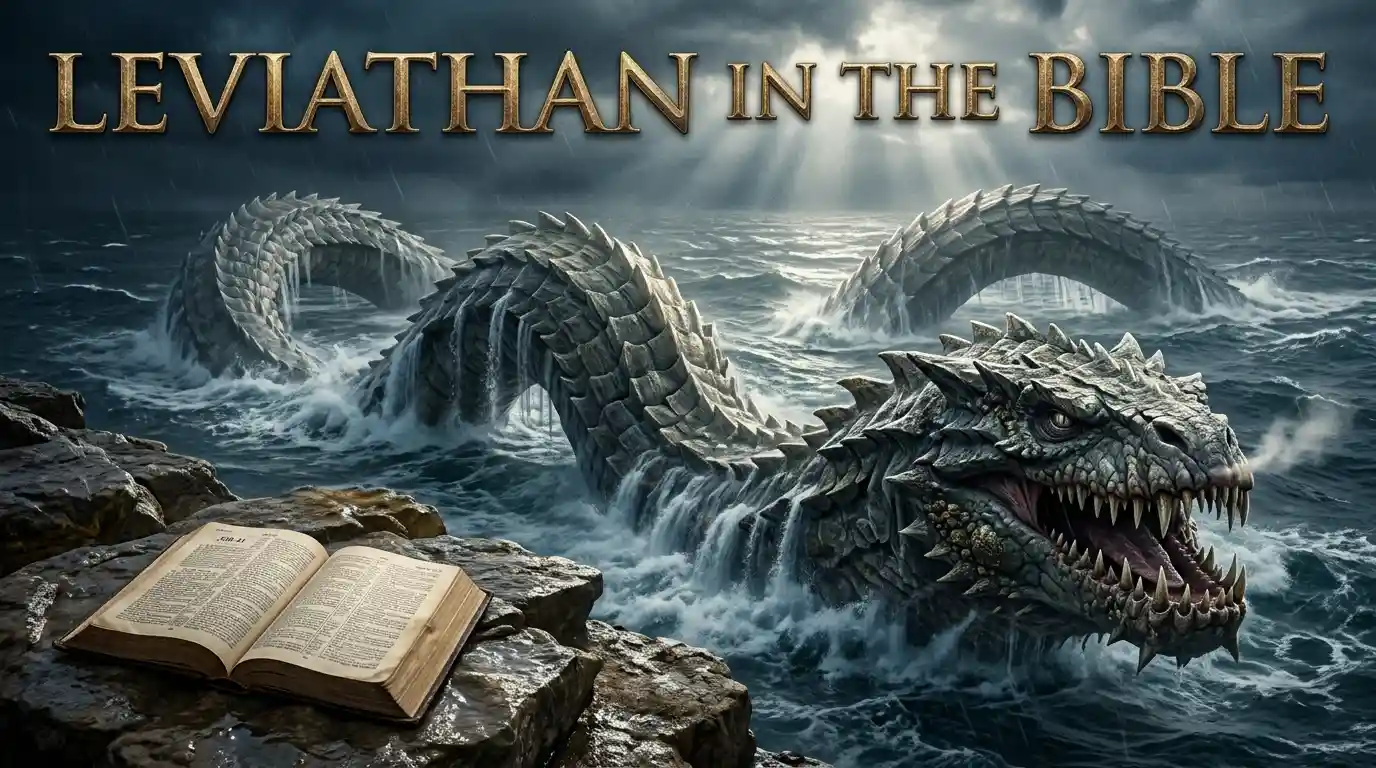
A biblical picture of Leviathan is often imagined as a massive, terrifying sea serpent or dragon with powerful jaws, thick scales, and an enormous body. This appearance comes mainly from Job 41, where God describes its frightening strength and unusual features. Some artistic interpretations also show Leviathan rising from deep ocean waters in front of Job. However, the Bible does not provide an exact visual illustration, so modern pictures represent artistic interpretations rather than confirmed historical appearances. St Andrews Encyclopaedia of Theology+2
Who killed Leviathan in the Bible
According to biblical passages, God is the one who defeats Leviathan. Psalm 74:14 describes God crushing its heads, while Isaiah 27:1 says the Lord will punish and kill the fleeing serpent called Leviathan. These verses present God as more powerful than every force of chaos and destruction. However, Job 41 does not describe Leviathan being killed; instead, it emphasizes that no human can overpower this extraordinary creature. Bible Gateway+2
Did God kill the Leviathan in the Bible
The Bible contains passages describing God’s victory over Leviathan, particularly Psalm 74:14 and Isaiah 27:1. Psalm 74 recalls God crushing Leviathan’s heads, while Isaiah describes the Lord punishing the twisting serpent with His mighty sword. These verses use powerful imagery to communicate God’s authority over chaos and evil. However, Job 41 presents Leviathan as a creature under God’s control without describing its death. The different passages serve different literary and spiritual purposes.
Leviathan as a Picture of Chaos and Enemy Power
In the Old Testament, the sea often stands for danger and disorder. Psalm 107:23-29, sailors in a storm cry to the LORD, who “maketh the storm a calm”. In Job 26:12-13, God “divideth the sea with his power” and His hand “formed the crooked serpent”. Against that background, Leviathan becomes a natural image for the forces that threaten life.
Psalm 74:14: Leviathan’s Heads Broken
Psalm 74 is a prayer from a time of national disaster, when the temple has been attacked (Psalm 74:3-7). The writer reminds God of His past victories: “Thou didst divide the sea by thy strength: thou brakest the heads of the dragons in the waters. Thou brakest the heads of leviathan in pieces, and gavest him to be meat to the people inhabiting the wilderness.” (Psalm 74:13-14)
Many readers connect these lines with the crossing of the sea in the Exodus (Exodus 14:21-28), where Pharaoh’s army was destroyed. The past tense matters: God has already won, and the psalmist asks Him to act again.
Isaiah 27:1: Leviathan Judged in the Future
Isaiah looks ahead: “In that day the LORD with his sore and great and strong sword shall punish leviathan. The piercing serpent, even leviathan that crooked serpent; and he shall slay the dragon that is in the sea.” (Isaiah 27:1)
The verse sits inside a promise to restore Israel as God’s vineyard (Isaiah 27:2-6) and to gather His people from “the land of Assyria” and “the land of Egypt” (Isaiah 27:13). Because of that setting, many readers see Leviathan here as a picture of the proud powers that oppress God’s people, with the final message that evil will not have the last word.
Related Images: Rahab and the Dragon
Other passages use similar sea-monster language for enemies of God’s people. Isaiah 51:9 asks, “Art thou not it that hath cut Rahab, and wounded the dragon?” Ezekiel 29:3 calls Pharaoh “the great dragon that lieth in the midst of his rivers”. These verses do not name Leviathan, but they show how the Old Testament uses sea-monster pictures to talk about powerful enemies, and always with God as the one who defeats them.
Does the Bible Borrow from Ancient Myths?
Scholars note that other Near Eastern peoples told stories of storm gods fighting sea serpents. The Ugaritic texts, for example, mention a seven-headed serpent called Lotan, a name close to Leviathan, and Isaiah 27:1’s twin “serpent” lines have a similar sound. The Bible uses the familiar picture, but changes the message. In Scripture, God is never in a struggle with an equal. Leviathan is something He “formed” (Psalm 104:26), puts “a hook” in (Job 41:1-2 shows only God can), and will “slay” (Isaiah 27:1).
Psalm 104:26: Leviathan at Play in God’s Sea
Psalm 104 is a song of praise for creation. Verse 25-26 turns to the sea: “So is this great and wide sea, wherein are things creeping innumerable, both small and great beasts. There go the ships: there is that leviathan, whom thou hast made to play therein.”
The contrast with Job 41 is striking. The creature that no human could tame is here a playful part of God’s good world. Leviathan is not God’s rival. It is one of His creatures, living in His sea, under His care. The psalm goes on to say that all creatures “wait all upon thee” for food (Psalm 104:27), and that includes the largest sea animals.
What Each Leviathan Passage Teaches
- Job 3:8: Even the darkest wishes of a suffering person are known to God (compare Job 23:10).
- Job 41: Human power is small; God’s power has no limit (Job 41:10-11).
- Psalm 74:14: God has beaten proud enemies before and can do it again (Psalm 74:13-14).
- Psalm 104:26: The wildest parts of creation are still held in God’s hand (Psalm 104:24-27).
- Isaiah 27:1: Evil powers will be judged in the end (Isaiah 27:1, 27:13).
Is Leviathan in the Book of Revelation?
The name Leviathan does not appear in the New Testament or in Revelation. But Revelation uses very similar pictures. Revelation 12:9 speaks of “that great dragon… that old serpent, called the Devil, and Satan”. Revelation 13:1 describes a beast that rises “up out of the sea” with “seven heads”. And in Revelation 21:1, John sees a new heaven and a new earth, and “there was no more sea”, which many readers take as the end of the old threat of chaos.
Because Isaiah 27:1 mentions a serpent and a dragon in the sea, and Revelation 12 and 13 describe a dragon and a sea beast, many Christians see a link between the two. The link is one of imagery. Revelation itself never says “this is Leviathan”.
Is Leviathan Satan or a Demon?
No verse in the Bible says Leviathan is Satan. In Job 41, Leviathan is a creature that God describes and controls. In Psalm 104:26, God “made” it. Psalm 74:14 and Isaiah 27:1, it is a sign of a defeated enemy. Satan is named in other places, such as Job 1:6-12 and Revelation 12:9, but not as Leviathan.
Later writers did connect Leviathan with the devil, because both are linked to serpent and dragon imagery (compare Isaiah 27:1 with Revelation 12:9 and Revelation 20:2). Stories, art and fiction then made Leviathan a demon of the sea. Those ideas are a later tradition, not something the Bible text teaches.
For daily faith, the Bible’s own instructions are clear. Believers are told to “Be sober, be vigilant; because your adversary the devil, as a roaring lion, walketh about” (1 Peter 5:8) and to “Resist the devil, and he will flee from you” (James 4:7). Nothing in Scripture tells believers to fear or bind a sea monster spirit called Leviathan.
What Leviathan Teaches Us Today
God Is Greater Than What We Cannot Control
If Leviathan cannot be pulled in with a hook (Job 41:1), then some forces in life are beyond our power: illness, loss, other people’s choices. The right response is humility and trust. Jesus showed this when He calmed a storm on the sea with the words “Peace, be still” (Mark 4:39), and His disciples asked, “What manner of man is this, that even the wind and the sea obey him?” (Mark 4:41).
Pain Does Not Always Come with an Explanation
Job never receives a full reason for his suffering. He receives a vision of God and responds with trust (Job 42:5). Readers who are suffering can take comfort that the same God who rules Leviathan also invites honest prayer. Psalm 62:8 says, “Trust in him at all times; ye people, pour out your heart before him: God is a refuge for us.”
Proud Powers Will Not Last Forever
Isaiah 27:1 promises a day when God will judge the great serpent of the sea. That does not give permission for hatred or revenge (Romans 12:19: “Vengeance is mine; I will repay, saith the Lord”). It does give hope that injustice is not the final word.
Even Frightening Things Belong to God’s World
Psalm 104:26 places Leviathan among the ships and the waves as part of God’s good design. That does not make the sea safe, but it does mean no part of creation is outside His care. As Psalm 139:9-10 says, “If I take the wings of the morning, and dwell in the uttermost parts of the sea; even there shall thy hand lead me.”
Frequently Asked Questions About Leviathan in the Bible
What is Leviathan in the Bible?
Leviathan is a great sea creature named in Job 3:8, Job 41, Psalm 74:14, Psalm 104:26 and Isaiah 27:1. It appears as an untameable beast (Job 41), a defeated enemy (Psalm 74:14; Isaiah 27:1), and a creature made by God (Psalm 104:26).
How many times is Leviathan mentioned in the Bible?
Six times in the Old Testament: Job 3:8, Job 41:1, Psalm 74:14, Psalm 104:26, and twice in Isaiah 27:1.
What does Leviathan symbolize in the Bible?
It symbolizes power that is far beyond human control (Job 41:10), the proud enemies of God’s people who will be judged (Isaiah 27:1), and the wild parts of creation that God still rules (Psalm 104:26).
Is Leviathan a real animal, a dinosaur, or a myth?
The Bible does not name a species. Features like scales (Job 41:15) remind readers of a crocodile, while fire and smoke (Job 41:19-21) point to poetic language. Some people suggest an extinct giant reptile, but the text does not say so.
Is Leviathan Satan?
No verse says so. Satan is named separately in places like Job 1:6 and Revelation 12:9. Later readers linked the two because of shared serpent and dragon imagery (Isaiah 27:1; Revelation 12:9).
What is the difference between Leviathan and Behemoth?
Behemoth is the great land creature of Job 40:15-24, and Leviathan is the great sea creature of Job 41. Both are made by God and both show His power over creation.
Is Leviathan in Revelation?
Not by name. But Revelation 12:9 and Revelation 13:1 use a dragon and a sea beast, images that echo Isaiah 27:1.
What does Psalm 104:26 mean when it says Leviathan plays in the sea?
It shows that Leviathan is one of God’s creatures, at home in the sea He made, and not an enemy of God. Even the most fearsome parts of creation live under His care (Psalm 104:24-27).
Conclusion
Leviathan appears in Job 3:8, Job 41, Psalm 74:14, Psalm 104:26 and Isaiah 27:1 as a coiling, powerful sea creature. In Job it shows how small human strength is (Job 41:10-11). Psalm 74 and Isaiah 27 it stands for proud enemies that God defeats. In Psalm 104 it is a creature at play in God’s own sea. The Bible never calls Leviathan Satan, though later readers have connected the images through Revelation 12:9.
The common message in every passage is the same: whatever seems too wild, too proud or too strong, God is greater. As Job learned, we can bring our hardest questions to Him and trust the Maker who rules even the deepest parts of the sea (Job 42:5; Psalm 104:24).

Michael Turner is a published fiction writer and creative writing tutor with over a decade of experience helping writers find the words that make their stories breathe ( Biography ).