
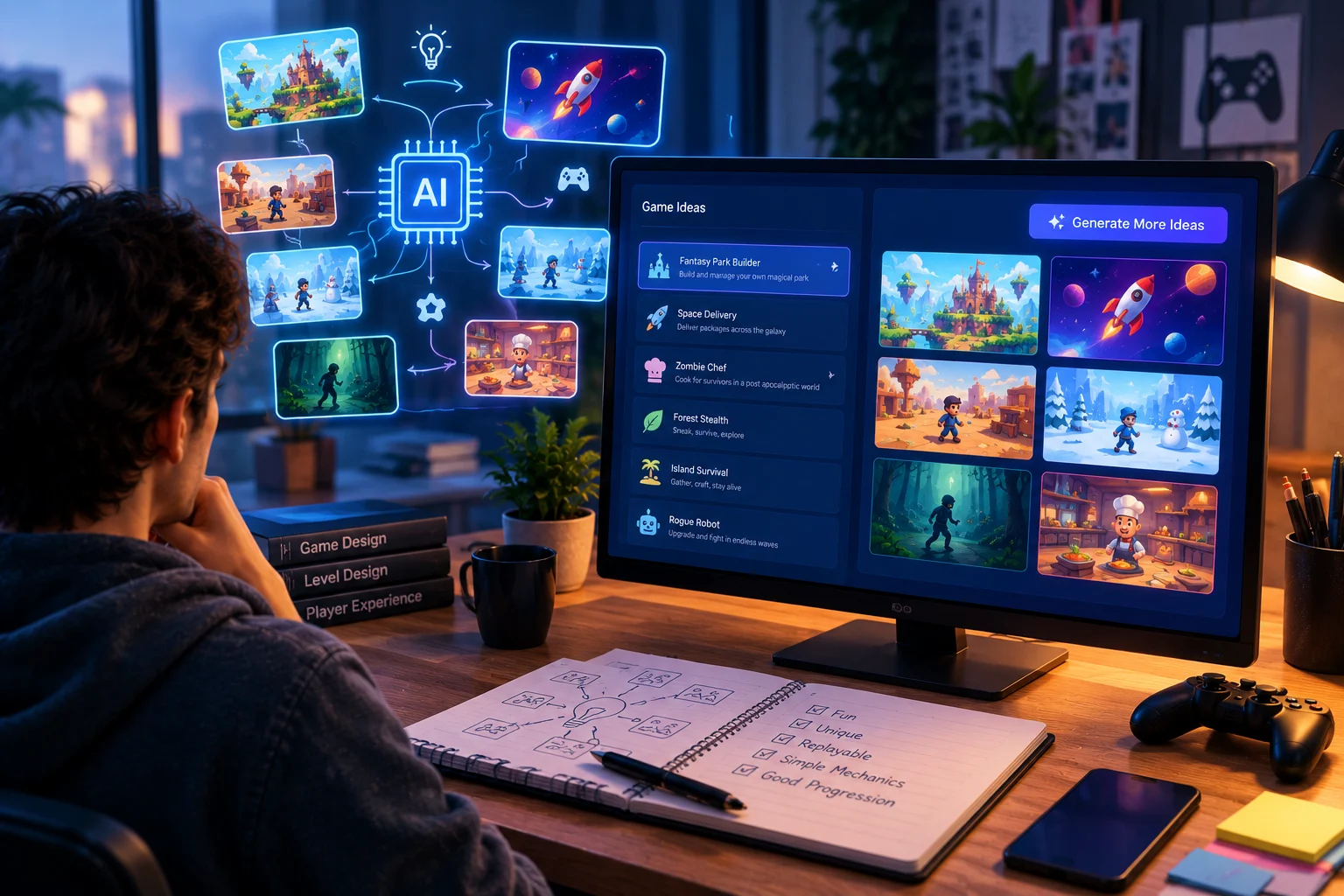
Brainstorming is supposed to feel expansive, but for a lot of creators it feels more like staring at a blank page hoping something clicks. The traditional version of brainstorming, sitting alone with a notebook trying to force original thoughts, often produces fewer usable ideas than people expect, simply because generating raw creative volume by yourself is slow and mentally exhausting. AI game makers are changing that dynamic, giving creators a much faster way to generate, react to, and refine ideas before committing real development time to any single one.
Why Traditional Brainstorming Falls Short
Generating Ideas Alone Is Slow by Nature
A single person can only produce so many genuinely different directions in a sitting before repeating themselves or running out of fresh angles. Brainstorming alone tends to circle back to familiar patterns, since it’s hard to surprise yourself with your own thinking.
Blank Pages Are Intimidating
Starting from nothing is one of the hardest parts of the creative process. Most people find it far easier to react to something concrete than to generate something out of pure imagination, which is exactly why staring at an empty document so often leads to stalling rather than progress.
How AI Changes the Brainstorming Process
Producing Volume Fast Enough to Spot Patterns
AI can generate a wide spread of directions, twists, and variations on a concept almost instantly. The value isn’t that any single suggestion is brilliant, it’s that seeing many options quickly lets a creator notice which ones genuinely excite them, something that’s much harder to judge from just one or two ideas developed slowly.
Giving Creators Something Concrete to React To
Rather than starting from a blank page, a creator can describe a rough theme or mechanic and immediately get back something specific enough to respond to. Reacting to a concrete suggestion, even one that isn’t quite right, is usually far easier than generating an equally specific idea from scratch.
Combining Unrelated Concepts Quickly
Some of the most interesting game ideas come from merging elements that don’t normally appear together, a builder mechanic with a horror theme, or a racing game with resource management. AI is particularly useful for quickly testing these unusual combinations, letting a creator explore territory they might not have thought to combine on their own.
Turning Brainstormed Ideas Into Something Testable
Ideas generated quickly are only useful if they can be tested just as quickly. This is where AI game makers extend past pure brainstorming into actually validating whether an idea has potential.
Why Speed From Idea to Prototype Matters
A great idea sitting on a list means nothing until it’s actually played. The faster a creator can move from a brainstormed concept to something playable, the more ideas they can realistically test before deciding which one is worth pursuing further.
A Platform Built to Support This Full Loop
Astrocade is a good example of an AI game maker that supports brainstorming all the way through to a playable build, letting creators describe an idea, see a rough version of it come to life, and quickly judge whether it’s worth developing further.
Seeing a Simple, Focused Idea in a Real Game
Pizza Masterpiece is a good example of a lighthearted, specific concept built around a clear hook rather than a sprawling feature list. Ideas like this often come out of exactly the kind of fast brainstorming process where a simple, familiar activity gets reimagined into something playful and easy to understand at a glance.
What Creators Still Need to Bring to Brainstorming
Knowing What Excites Them Personally
AI can widen the pool of options, but it can’t tell a creator which idea they’ll actually feel motivated to keep working on. Personal enthusiasm for a concept matters enormously for seeing a project through, and that judgment still has to come from the creator.
Filtering Ideas Against Realistic Scope
Not every generated idea is realistic to build, especially for a solo creator or small team. Part of the brainstorming process still involves filtering exciting ideas against what’s actually achievable, rather than chasing the most ambitious option simply because it sounds impressive.
Recognizing a Good Idea That Needs Refinement
Sometimes a suggestion is close to good but not quite right as originally generated. Creators need the judgment to recognize when an idea has real potential buried in it, even if the first version needs meaningful adjustment before it works.
Common Mistakes in AI-Assisted Brainstorming
Accepting the First Idea That Sounds Interesting
The first exciting-sounding suggestion isn’t necessarily the best one. Creators who stop brainstorming too early often miss stronger variations that would have come up with a bit more exploration.
Generating Ideas Without a Starting Direction
Brainstorming completely without constraints tends to produce a scattered mix of unrelated concepts that are hard to compare against each other. Starting with even a loose theme or mechanic in mind tends to produce more useful, comparable results.
Skipping the Step of Actually Building Something
It’s possible to spend so much time generating and comparing ideas that none of them ever get tested in a playable form. Brainstorming should lead somewhere, and that somewhere needs to be an actual prototype, not just a longer list of concepts.
A Practical Approach to Faster Creative Brainstorming
A reasonable process looks like this. Start with a loose theme, mechanic, or feeling you’re drawn to, rather than an entirely open prompt. Use an AI game maker to generate a range of variations and combinations around that starting point, and resist settling on the first one that sounds appealing. Narrow the list down to a couple of ideas with a clear hook, then move quickly into building a rough playable version of each rather than continuing to brainstorm indefinitely. Let actual play, not discussion, decide which concept is worth developing further.
Final Thoughts
AI game makers haven’t replaced the creative spark that makes an idea worth pursuing, but they’ve made the process of getting to that spark dramatically faster. For creators who used to lose momentum staring at a blank page, having a fast way to generate, react to, and test ideas removes one of the biggest obstacles standing between a vague notion and an actual game worth playing.

Michael Turner is a published fiction writer and creative writing tutor with over a decade of experience helping writers find the words that make their stories breathe ( Biography ).