Quick Intro
The word emotionless appears in everyday conversations, academic writing, psychology discussions, and storytelling. It describes a person or expression that shows little or no emotion. Learning synonyms helps improve clarity and variety in writing and speaking.
Using different words instead of repeating the same term can make communication more precise and natural.
Direct Answer
Meaning of Emotionless
Emotionless means showing no feelings, reactions, or emotional expression in behavior, speech, or facial expression.
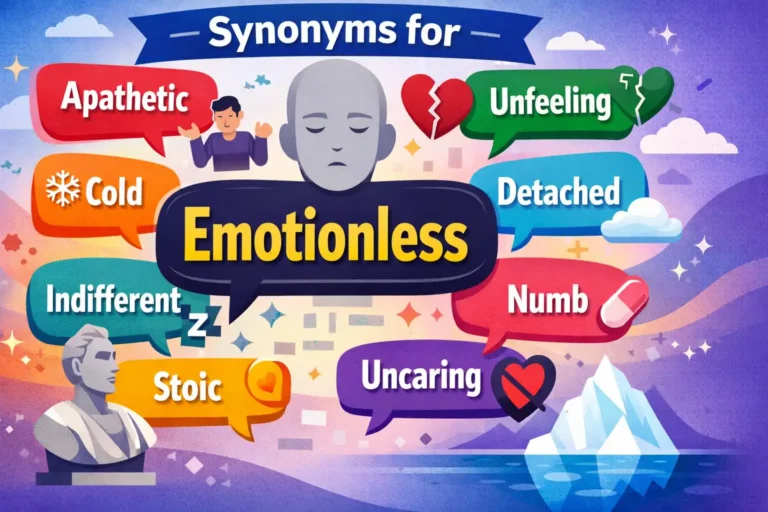
Common synonyms include:
- Unemotional
- Impassive
- Stoic
- Cold
- Detached
- Expressionless
- Unresponsive
- Reserved
- Indifferent
- Calm
Categories of Synonyms
Neutral or Controlled Emotion
These words describe someone who appears calm or controlled rather than openly emotional.
Examples include stoic, reserved, unemotional, calm.
Lack of Visible Expression
These synonyms focus on a face or reaction that shows no emotional signals.
Examples include expressionless, impassive, blank, unresponsive.
Emotional Distance or Coldness
These words suggest a person feels emotionally distant or disconnected.
Examples include cold, detached, indifferent.
Synonyms Table
| Word | Simple Meaning | Example Sentence |
| Stoic | Calm and not showing emotion | The doctor remained stoic during the difficult conversation. |
| Impassive | Showing no visible emotion | Her impassive face revealed nothing. |
| Unemotional | Not showing feelings | He gave an unemotional response to the news. |
| Detached | Emotionally distant | She sounded detached while discussing the problem. |
| Expressionless | Showing no facial emotion | His expressionless face worried his friends. |
| Cold | Lacking warmth or feeling | His cold reaction surprised everyone. |
| Indifferent | Not caring emotionally | She seemed indifferent to the outcome. |
| Reserved | Quiet and controlled with emotions | He stayed reserved during the discussion. |
| Unresponsive | Not reacting emotionally | The audience remained unresponsive. |
| Blank | Showing no expression | Her blank stare confused the teacher. |
Master Synonyms List (Grouped by Level)
Beginner / Simple Synonyms
Cold
Meaning: showing little warmth or emotion
Example: She gave a cold response to the apology.
(Formality: Informal)
Calm
Meaning: quiet and controlled emotionally
Example: He stayed calm even during the stressful meeting.
Blank
Meaning: showing no facial emotion
Example: The student looked blank after hearing the question.
Reserved
Meaning: controlled and not openly emotional
Example: She remained reserved during the conversation.
Intermediate Synonyms
Unemotional
Meaning: not expressing feelings openly
Example: His unemotional explanation surprised the team.
Detached
Meaning: emotionally distant from a situation
Example: The manager sounded detached when discussing the problem.
Indifferent
Meaning: not emotionally interested or concerned
Example: He seemed indifferent to the criticism.
Unresponsive
Meaning: not reacting emotionally or physically
Example: The patient remained unresponsive during the test.
Advanced / Formal Synonyms
Stoic
Meaning: calmly accepting situations without emotional reaction
Example: The leader stayed stoic despite the pressure.
(Formality: Formal)
Impassive
Meaning: not showing emotion or feeling
Example: Her impassive face revealed no opinion.
(Formality: Formal)
Expressionless
Meaning: showing no emotion in the face
Example: His expressionless stare made others uncomfortable.
(Formality: Neutral)
Formal vs Informal Synonyms
Some synonyms for emotionless work better in formal contexts, while others fit everyday conversations.
Formal language
- Stoic
- Impassive
- Detached
These are common in academic writing, literature, and psychology discussions.
Informal or casual language
- Cold
- Blank
- Calm
These are more common in conversations and casual writing.
Choosing the right level of formality helps make communication more appropriate for the audience.
Real-Life Usage Examples
Conversation
“Why does he look so emotionless today?”
Academic Writing
The participants remained emotionally neutral and appeared stoic during the experiment.
Business Writing
The manager maintained a calm and detached tone while presenting the results.
Blogging
Some people appear emotionless in photos because they feel uncomfortable in front of cameras.
Emotional Expression
His impassive reaction made it difficult to understand how he truly felt.
Similar Words Comparison
Emotionless vs Stoic
Emotionless means showing no emotions at all.
Stoic means controlling emotions intentionally, especially during difficult situations.
Example:
He remained stoic during the crisis.
He looked emotionless while listening to the story.
Emotionless vs Detached
Emotionless refers to lack of emotional expression.
Detached suggests emotional distance or lack of personal involvement.
Example:
Her voice sounded detached during the discussion.
His face appeared completely emotionless.
Example Sentences
- The judge remained emotionless during the hearing.
- Her impassive face made it difficult to read her thoughts.
- He gave a cold reply to the suggestion.
- The teacher kept a calm and controlled expression.
- She appeared detached from the argument.
- His blank expression confused everyone in the room.
- The manager stayed stoic under pressure.
- His unemotional tone surprised the audience.
- The actor practiced an expressionless look for the scene.
- She seemed indifferent to the final decision.
- His reserved personality made him appear emotionless.
- The crowd remained unresponsive during the speech.
- Her impassive reaction worried her friends.
- The scientist kept a detached perspective during the experiment.
- His cold reaction disappointed the team.
Common Mistakes
Using “emotionless” for calm situations
Sometimes a person is calm, not emotionless.
Incorrect:
He was emotionless during meditation.
Better:
He was calm during meditation.
Confusing “stoic” with “cold”
Stoic means controlled emotions, not lack of caring.
Overusing one synonym
Repeating the same word like cold or detached can weaken writing.
Using formal words in casual speech
Words like impassive may sound unnatural in everyday conversation.
Tips / Best Practices
- Choose synonyms based on tone and context.
- Use formal words in academic writing.
- Use simple words in everyday speech.
- Avoid repeating the same word many times.
- Focus on clarity rather than complex vocabulary.
Good writing balances variety with natural language.
When NOT to Use Emotionless
Avoid using emotionless when describing:
- Calm or relaxed behavior
- Thoughtful silence
- Professional neutrality
For example, a doctor speaking professionally may appear calm but not emotionless.
Opposite Words (Antonyms)
Common antonyms for emotionless include:
- Emotional
- Expressive
- Passionate
- Sensitive
- Warm
- Compassionate
- Enthusiastic
These words describe strong emotional expression.
FAQs
What does emotionless mean?
Emotionless means showing little or no emotional reaction, expression, or feeling.
Is emotionless a negative word?
It can be neutral or negative depending on context. Sometimes it describes calm control, while other times it suggests emotional distance.
Is emotionless formal or informal?
The word itself is neutral and works in both casual and formal writing.
What is the best synonym for emotionless?
Common alternatives include stoic, impassive, unemotional, detached, and expressionless.
Can emotionless describe a facial expression?
Yes. It is often used to describe a face that shows no emotion.
Is stoic the same as emotionless?
No. Stoic means controlling emotions intentionally, while emotionless means showing no emotion.
Can emotionless describe personality?
Yes. It can describe someone who rarely shows feelings.
How can I use emotionless in conversation?
Example: “He looked emotionless when he heard the news.”
Is emotionless common in writing?
Yes. It is common in storytelling, psychology, and descriptive writing.
Can emotionless be replaced with impassive?
Yes, especially in formal writing.
Conclusion
Learning synonyms for emotionless improves vocabulary and communication. Different alternatives such as stoic, detached, impassive, and reserved help express subtle differences in emotional behavior.
Using the right synonym can make writing clearer and more natural. Try using three new synonyms from this article in your next sentence to strengthen your vocabulary.

Michael Turner creates simple synonym guides that help readers expand their vocabulary and choose the right word for the right context.